for parents tired of doing it all

you stop being the short-order cook.
they start being the chef.

Short cook-along videos with Kaja and Kamilla, then real knives, real plant food and a real dinner on the table. Picky eaters eat what they make.

Their first dinner could be this week.

1,600 families have cooked with us.

100% whole plant-based gluten-free soy-free peanut-free allergy swaps included
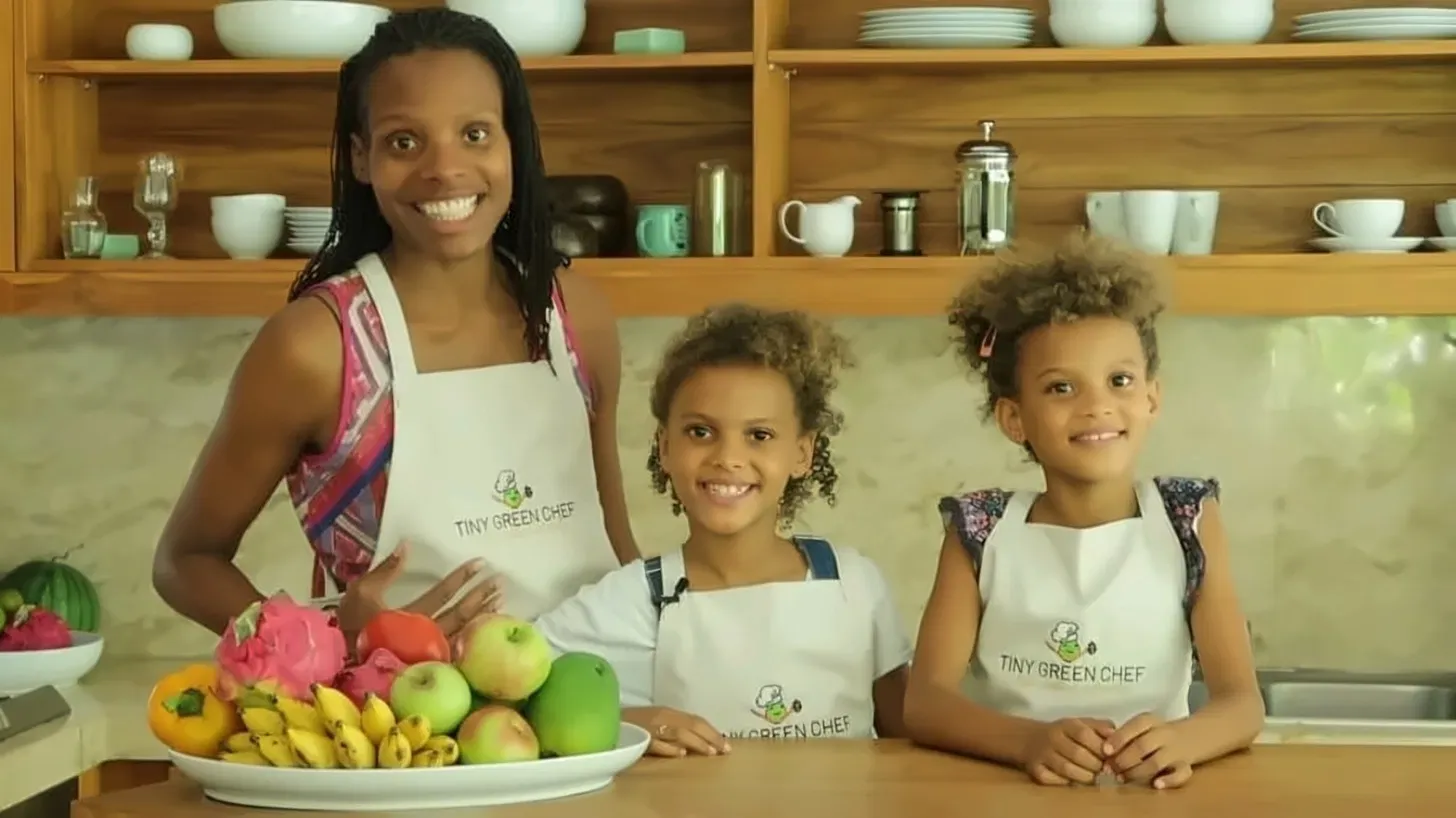
Tiny Green Chef cooking lessons with Azizi, Kaja and Kamilla
30minutes or
less a lesson
"Cooking is fun, it's like you're a scientist!"

Kamilla, co-creator, age 8

sound familiar?

  • You think about dinner all day, even when you're not cooking.
  • You make a second meal for the one who won't eat the first.
  • It's faster to do it yourself. So you do. Every night.
  • They're on a screen while you're at the stove.

doing it for them feels like love. it's also why they can't.

Kids push back on food that's done to them. They lean in to food they made.

Not more hiding. Not more pressure. A kid who picked the carrots, cut them, and can't wait for you to taste.

the old-fashioned way

not another level on a screen. a real dinner on the table.

Remember flour on the counter, a stool by the stove, and something you made with your own hands? A lot of kids don't get that anymore.

Tiny Green Chef brings it back. The screen starts it: a short video with Kaja and Kamilla. The kitchen finishes it: real knives, real food, and a dinner the whole family eats.

video games give them points. the kitchen gives them proof.

88%

of parents wish their kids played more like they did growing up.

Talker Research for Celebree School, 2026


7 in 10

have tried to recreate hands-on projects they did with their own parents.

Talker Research for Lowe's, 2026

why teach a kid to cook?

it changes their plate, your table, and the adult they become.

for them, now

less fussy, more curious.

In a study of about 300 Swiss families with kids aged 6 to 12, the children who helped cook were the least fussy eaters. Pressure to eat had the opposite effect.

The kitchen is also an edible classroom: reading a recipe, measuring, science, and a hundred small decisions they get to make themselves.

van der Horst, ETH Zurich, Appetite, 2012

for your home

fewer battles, more meals together.

When the cook at the table is your kid, you stop being the enforcer. You become the taster.

Young adults with good cooking skills went on to have more family meals and less fast food once they had families of their own.

Utter et al., Project EAT, 2018

for their future

healthy choices, without you there.

A 10-year study followed young people into their thirties. Those with stronger cooking skills were more likely to prepare vegetable meals and ate fast food less often.

Cooking skills become how your kid takes care of themselves.

Utter et al., Project EAT, 2018

49%

of U.S. children ages 1 to 5 didn't eat a vegetable every day in the week before they were surveyed.
2021 National Survey of Children's Health, CDC report, 2023.
why it works

four things the research keeps finding. we built every lesson on them.

1

what they make, they want.

People enjoy healthy food more when they prepare it themselves. Psychologists link it to the IKEA effect: we value what we built.

So your child does the work. Every recipe.

Dohle, Rall and Siegrist, Health Psychology, 2016

2

pressure backfires.

Preschoolers told to finish their soup ate less of it, and complained more, than when no one pushed.

So curiosity leads. No one has to clean their plate.

Galloway et al., Appetite, 2006

3

variety grows bit by bit.

A review of 30 studies found repeated tasting worked best. Researchers suggest offering a vegetable 8 to 10 times.

So foods come back in new forms, module after module.

Nekitsing et al., Appetite, 2018

4

kids learn from kids.

Preschoolers who watched a video of other kids eating bell peppers ate significantly more bell pepper a week later.

So Kaja and Kamilla cook along in every lesson.

Staiano et al., 2016

meet your co-instructors

they're not watching a chef. they're cooking with two kids.

Kaja and Kamilla were 10 and 8 when we filmed Tiny Green Chef in Bali. They cook every recipe right alongside your child, kid to kid. Here they are, in their own words.

Tiny Green Chef family photo
Tiny Green Chef, filmed in Bali.
Kaja at age 10 with a smoothie

Kaja

age 10 when we filmed
proudest dishAsian zoodle soup
favorite fruitrambutan
favorite vegetableraw carrots
favorite kitchen skillcutting
"When I'm cooking I really look forward to eating it."

Today: published her first book at 13.

Kamilla preparing veggie sushi

Kamilla

age 8 when we filmed
proudest dishveggie sushi
favorite fruitmango
favorite vegetablelettuce
favorite kitchen skillcutting
"Cooking is fun, it's like you're a scientist!"

Today: writes the Captain Compass Explores books.

Child cutting avocado

Notice their favorite skill? Both said cutting. The knife is the thing parents fear most. It's the thing kids are proudest of.

more responsibility, not less

doing it for them feels kind. it isn't.

Most of us were raised to think protecting kids means keeping them out of the kitchen. Away from the knife, the stove, the mess.

But kids rise to the job you hand them. A real job, with real tools, that feeds real people.

The kitchen is the safest place to start handing it over.

~10,000

kids were followed from kindergarten to third grade. Those who did regular chores early showed more self-competence, helpfulness, and confidence.

White, DeBoer and Scharf, 2019

multi-step tasks matter

A survey of 200+ families linked doing chores with stronger working memory and self-control. Multi-step jobs such as cooking can stretch kids.

Tepper et al., 2022

why plants?

because it's better for them, and simpler for small hands.

Well-planned plant-based diets can support children's nutritional needs. Choosing whole plant foods also gives children a wide range of colors, textures and flavors to explore.

kids can do more of it

No raw meat to handle, so children can wash, cut, mix and taste as they go.

allergy-friendly by design

Recipes are gluten-free, soy-free and peanut-free, with swap suggestions.

variety, bit by bit

Every color, crunch and flavor brings a new discovery.

whole, not processed

They learn real ingredients and even make pasta and gluten-free flour.

everyday ingredients

Familiar fruits and vegetables, without unnecessarily complicated shopping.

no need to be vegan

Every family can benefit from more fruits and vegetables.

inside one session

every session has the same rhythm. tap through it.

first: the kitchen science

they get to know one ingredient.

Every session opens with an experiment using a food from that day's recipe, so they understand it before they cook with it.

Lesson one: lemon on a cut apple helps keep it fresh. They explore what happens and why.

a fun food fact ends every recipe

they learn the story of the food on their plate. try a few.

the four modules

each module has a job. together, they make a cook.

The modules build on each other. By the end, your child has well over 60 cooking skills and the know-how to make healthy decisions on their own.

30+

cooking lessons

20

science experiments

20

health lessons and facts

60+

cooking skills

01 — basics of beneficial foods

Why plant foods are good for the body and how to choose quality ones, while making quick, simple, satisfying meals.

02 — easy sensory meals

Using all five senses to understand food, then building easy meals from food templates, without always following a recipe line by line.

03 — simple and satisfying selection

Ways to preserve and process foods so they can be eaten in a different way, while retaining flavor and nutrition.

04 — time, temperature and taste

Cooking with heat to change taste and texture, plus an easy gourmet raw dessert as a bonus in each session.

making it work in your home

four steps. any kitchen. any week.

01. pick a lesson, grab the list.

Print the grocery list, shop together, set out a knife, a blender and a bowl.

02. press play and hand it over.

Kaja and Kamilla lead. Your child follows them, not you. You assist; you don't direct.

03. sit down and taste it.

Eat what they made. Ask what they'd change. Let them tell you the food fact.

04. step back a little more.

Next session they take one more job. Then another. That's the whole method.

what you have to look forward to

picture your kitchen a few months from now.

✓ They ask to make dinner. And mean it.
✓ A new vegetable shows up and nobody fights about it.
✓ They explain why lemon keeps an apple fresh. To you.
✓ They handle a knife with care and pride.
✓ They make healthy choices, even without you there.
✓ Dinner is something you make together, not referee.

tap your chef's age

what they can do. what you can let go of.

they can

Run most of the session themselves, from experiment to plate.

you let them

Step back to taster. Ask what they would change next time.

Azizi, founder of Tiny Green Chef

who we are

a mom and two kids who built this at their own table.

I'm Azizi, a vegan chef with over two decades in health and wellness. I've homeschooled my daughters across the world, and they've been in the kitchen with me since birth.

Kaja and Kamilla created Tiny Green Chef with me when they were 10 and 8. We dreamed it up in Guatemala and filmed it in Bali. They cook along in every lesson, so your child learns from kids, not a lecture.

Before it was a course, it was Little Wild Kitchen: live cooking camps in Bali where kids designed the menu, learned the why behind every ingredient, and served their parents at the end.

why you can trust us with your kitchen.

a vegan chef in your corner

Plus 20+ years in health and wellness.

award-winning kid cooks

Kaja and Kamilla have won cooking competitions.

the sleepover test

When the girls visit friends, people ask them to bring their food.

tested with real kids, live

Little Wild Kitchen camps came first. Then 1,600 families at home.

what we're about

We're not here to make kids eat their vegetables. We're here to raise kids who choose them, even when you're not watching.

hands-onover lectures
curiosityover pressure
whole plantsover processed
kids leadparents step back

1,600

families served

20+

years in health and wellness

2

kid co-creators

from families who cook with us

the kids learned the knife. the parents learned to step back.

"The boys liked learning how to safely use a knife and I liked learning different ways to incorporate nutritious food in an easy, fun and imaginative way."
Allison, Tiny Green Chef parent
[Avital testimonial to be inserted]
Avital Schrieber Levy
[Brandy testimonial to be inserted]
Brandy Montague
[Tabitha testimonial to be inserted]
Tabitha Crocker

so here's the choice.

keep going as you are

  • More creative ways to dodge dinnertime battles.
  • More rejected plates and worry about what they're missing.
  • More waiting to see if they grow out of it.
  • You, doing it all, so they never have to.

hand them the spoon

  • A kid who's excited to explore plant foods.
  • A real connection to the food on their plate.
  • Skills for healthy decisions far beyond the kitchen.
  • You, at the table, being served.
yes, let's start cooking

one price. lifetime access.

their first real dish could be this week.

You'll measure progress by what changes at your own table.

What you'll need: basic knives, a blender, and a food processor. No dehydrator, no specialty gear, no hard-to-find ingredients.

$97 $249 one-time, USD

  • 4 cumulative modules, self-paced, for life
  • 30+ cooking lessons with Kaja and Kamilla
  • 20 kitchen science experiments
  • 20 health lessons and fun food facts
  • Grocery lists and printable guides
  • Plant-based cooking hacks and allergy swaps
start cooking today
30-day money-back guarantee.

Press play and cook with us. If it's not for your family, tell us within 30 days for a full refund, no questions asked.

questions parents ask

What ages is it for? +

Kids as young as 3 can cook with you. Around 5 or 6 they start grasping the concepts; by 7 or 8 they get the full benefit, and older kids can work more independently.

Does it come with a grocery list? +

Yes. Every recipe comes with a complete grocery list.

How long is each lesson? +

Each lesson is under 30 minutes, leaving time to cook, eat and enjoy the food.

Is this really allergy-friendly? +

The recipes are gluten-free, soy-free and peanut-free. Families should still check ingredient labels and use substitutions appropriate to their needs.

Can I get substitutions for other allergies? +

Swap recommendations are included, and you can reach out with your family's needs.

Do we need to be vegan? +

Not at all. Every family can use more fruits and vegetables.

Do you use a lot of oil? +

No. Where we use coconut or olive oil, you can leave it out, and we teach a no-oil stir-fry method.

Is this really lifetime access? +

Yes. You keep access to the whole program for life.